
Resistance training is an essential component of any exercise program. The American College of Sports Medicine (ACSM) recommends loading exercises for all healthy adults in order to maintain bone and muscle health. Loading exercises are defined as drills that use body-weight or any resistance tool (free weights, bands, or machines) to create a physiological challenge. Overloading the body places muscles, bones and joints under (controlled) stress, which induces positive adaptations such as increase in muscle mass, strength gain, and bone mass improvement.
Unfortunately, not many women participate in this type of activity, probably because they don’t know where to start. I understand that the weight-room can be overwhelming with all the different equipment such as machines, barbells, dumbbells, bands and balls, to name a few. Even when they can recognize a machine, chances are they don’t know what it is for.
Thus, my goal is to help you with the basics. I’ll explain a few principles of programming which may help you put together your very first routine.
Exercise Frequency
According to the ACSM, for general muscular fitness, an individual should perform two to three resistance training sessions per week with at least 48 hours of rest between sessions. The training routine should address all major muscle groups to promote symmetry and avoid muscle imbalances.
For beginners, two sessions per week is a good start. However, two sessions per week also means that you should use a whole-body routine, i.e., a routine that targets all major muscle groups in every single session. More advanced exercisers may choose to split their routines into upper- and lower-body days, for examples. Keep in mind that splitting your routine will ultimately require more training sessions per week (four instead of two).
Exercise Selection
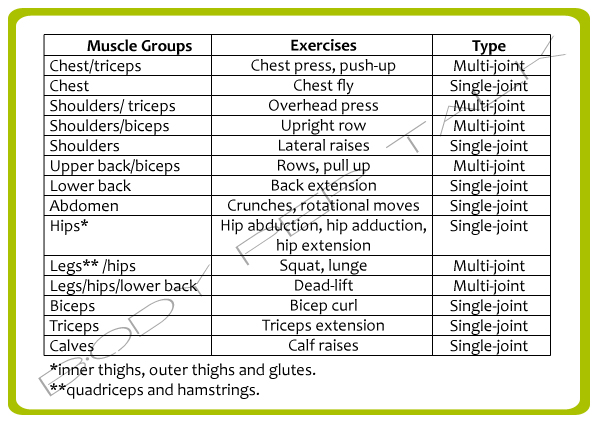
A whole-body routine should focus on multi-joint or compound exercises in order to be time-efficient. Multi-joint exercises are the ones that engage more than one joint and several muscle groups at once. For example, a push-up primarily engages the chest and triceps muscles to lift your body away from the floor. Compound exercises are the ones that integrate two movements in one drill such as a squat with an overhead press. Also, a few single-joint exercises may be included in the routine in order to round up the program. Single-joint exercises are the ones that mobilize only one joint and usually engage a single muscle group. An example is a bicep curl.
The major muscle groups are chest, shoulders, upper- and lower-back, abdomen, hips, and legs. Arm and calf muscles should also be included in the programming. Select eight to 10 exercises that involve each one of these muscles.
Exercise Sequence
A simple principle to follow is to start your workout with the compound and multi-joint exercises, finishing with the single-joint ones. In addition, begin your routine with the most demanding exercises. Doing these exercises while you are fresh increases your chances of performing them correctly.
Exercise Volume: Sets and Reps
Repetitions are the number of times you perform a movement, while sets are the number of times you perform an exercise. For example, consider a lateral raise exercise. The movement is holding a pair of dumbbells at your sides, lifting your arms straight until they are parallel to the floor, and then, slowly bringing the arms down. This is one repetition. A set would be performing this same movement eight to 12 times (number of repetitions per set). This is an adequate range to improve muscle strength, mass, and endurance.
Keep in mind that each muscle group should be trained for a total of two to four sets. Start with two sets of each exercise, progressing to four sets (if you wish to improve your results). Recovery time is also important. Spend two to three minutes resting between each set or exercise.
Weight Selection
To select the appropriate resistance, you can use the following principle: Choose a weight/resistance that allows you to perform between eight and [12] repetitions, but no more than that. Remember that the whole point is to create a challenge, meaning that if you can perform infinite repetitions, you should increase the weight/resistance.
Also, keep in mind that each exercise will require different loads, so properly select the weight/resistance. Using one pair of dumbbells for all exercises is not only ineffective; it may also be dangerous. If you are struggling to maintain proper form during an exercise, reduce the resistance. You don’t need to injure yourself just because you don’t want to change weights.
Exercise Progression
In order to keep seeing improvements in muscle fitness, it is important to progressively increase the challenge. This may mean increasing the weight/resistance or choosing a more challenging exercise variation (such as going from a knee push-up to a full push-up). A rule of thumb for increasing the load is: when you can perform 12 repetitions of an exercise for two weeks consecutively, you may increase the weight/resistance, even if it means [performing] fewer repetitions. Then, work your way up to 12 reps with the new weight. The exception is for maintenance purposes. People who just want to maintain their fitness status may keep the same resistance indefinitely.
References
Baechle, T. et al. Essentials of Strength Training and Conditioning. Champaign, IL: Human Kinetics. 2008.
Bryant, C., et al, eds. ACE Personal Trainer Manual. The Ultimate Resource for Fitness Professionals. San Diego: American Council on Exercise. 2003.
Thompson, W., et al, eds. ACSM’s Guidelines for Testing and Prescription. Baltimore, MD: Woters Kluwer and Lippinicott Williams & Wilkins. 2010.
Wilmore, J., Costill, D. and Kenney, W. L. Physiology of Sport and Exercise. Champaign, IL: Human Kinetics. 2008.