
With the current news about inorganic arsenic found in rice and rice products, many of you may be looking for healthy alternatives that combine nutrition and flavor. If so, I’d suggest you try barley. Barley is a grain that has a nutty flavor similar to brown rice. It is a great source of fiber and protein, low in fat and cholesterol free. It also provides many vitamins, minerals, antioxidants, and phytochemicals. In addition, barley has a low Glycemic Index (GI), which means that it is digested slowly, thus not causing a spike in blood sugar levels. But beware! Barley contains gluten, so if you have gluten sensitivity or celiac disease, you should discuss it with your health care provider before introducing it into your diet. For a whole grain alternative to brown rice, look for minimally processed varieties such as hulled or hulless barley. Pearl barley undergoes more processing, so it loses some of its nutritional content and is not considered to be a whole grain.
Not So Sweet
Do you usually reach for diet soda (or any other sugar-free treats) to satisfy your sweet tooth? I’m sorry to say that I have bad news for you. It seems that the artificial sweeteners present in many diet foods and beverages can actually cause weight gain in the long run. An article published on the Yale Journal of Biology and Medicine revised several studies correlating artificial sweeteners and obesity rates. Experiments point out that sweet taste stimulates appetite. However, when sweetness is not accompanied with its correspondent calories, the response to eat more may be exacerbated. This is because sugar activates food reward pathways in the brain, creating a pleasurable sensation. The problem is that artificial sweeteners can’t seem to generate the same response, and don’t lead to full satisfaction. This means that you will keep looking for more to try to satisfy your needs. Besides, it seems that when your tongue perceives the taste of sweet, your body expects a certain amount of calories with it, and if these calories don’t come in, the brain triggers a compensatory overeating behavior in order to fulfill its expectations.
The Power of a Food Journal
Trying to shed a few pounds? If so, you may want to start keeping a food journal. A recent research published on the Academy of Nutrition and Dietetics showed that women who kept food journals consistently lost about six pounds more than those who did not. This is because recording food and beverage intake bring awareness to our eating habits and encourage us to evaluate our choices before consumption. Keeping a food log may even discourage consumption of some foods, which may not be a bad outcome. In addition, you may be able to understand your eating behaviors (such as eating when stressed or bored), identifying their triggers, and potentially coming up with different ways to cope with diversities.
To Eat, Or Not To Eat: That Is the Question
Have you ever wondered whether or not you should eat before working out? Many folks tend to avoid eating before exercising in the hopes of burning more fat. Even though many fitness gurus defended this idea, a study published on the International Journal of Sport Nutrition and Exercise Metabolism refuted this myth. The study compared a group of volunteers in two different states: fasting and having a light breakfast before training sessions. The goal was to measure the caloric expenditure after the exercise session and the amount of fat that was being used as fuel. It was found that when the subjects ate before exercising, they burned slightly more calories 12 to 24 hours after the session than when fasting. In addition, it seemed that when they had breakfast before training, they used more fat as fuel after the exercise session.
Preventing Common Injuries
According to Michael Boyle, author of “Advances in Functional Training,” most injuries in sports seem to be caused by very common muscle imbalances. Injuries tend to occur when stabilizing muscles are weak and fail to neutralize the stress placed on a joint and its structures. Moreover, whenever there is an imbalance between opposing muscle groups, the body tends to recruit other muscles in an attempt to stabilize the forces in the particular region. The problem is that those muscles were not designed for this function and won’t be able to do a good job, which allows some of the stress to be placed on joints, tendons and ligaments. As this abnormal muscle activation becomes frequent, it alters the relationship between the opposing muscles, affecting posture, body alignment, and movement patterns.
Excess Belly Fat Kills More
Many people think that because they are not “overweight” by the American standards (weight/height tables and Body Mass Index), they are free to be sedentary and have poor eating habits. Well, if this is your case, you better think again. A new research from the Mayo Clinic found out that people with normal body weight, but with excess fat around the waist are more likely to die from cardiovascular disease than anybody else. This proves that it’s not how much fat you have on your body that matters, but where it is deposited. It seems that abdominal fat has a toxic effect on the body and is associated with coronary artery disease, high blood pressure, and diabetes, among others. According to the researchers, when it comes to determining your risk for cardiovascular disease, you must pay attention to your waist-to-hip ratio, i.e., the waist circumference divided by the hip circumference. A waist-to-hip ratio greater than 0.86 for women, and greater than 0.95 for men, indicates abdominal obesity and increases one’s risk of developing cardiovascular disease in the future.
Know Your Load
Have you ever walked around the gym wondering how much weight you should use for a particular exercise? In my experience, women tend to go for the lighter weights, while men tend to choose weights that are way too heavy. This happens because most women are afraid of getting too bulky, so they choose light loads and perform more repetitions. Men, on the other hand, seem to be too proud to admit that they are not there yet, so they compromise form in order to lift heavier weights. Even though I don’t recommend going overboard with the load, I have to admit that men usually get better results with their training mentality. This can be explained by the progressive overload principle.
Chicken and Beans Salad
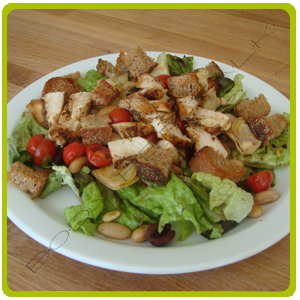 This is high-protein salad (from beans, chicken, and pine nuts), yet a light and fresh dish that can be enjoyed for lunch or dinner. It is also rich in fiber and antioxidants, while low in fat. This recipe yields a reasonable portion that will make you feel satisfied for hours. In addition, it is quick and easy to prepare.
Do You Count Calories?
Nowadays, watching what you eat has become a rather common habit. Many people have learned to count calories, hoping that it will solve their body-weight issues. However, is measuring every single thing you put in your mouth a healthy practice? Many experts believe it can do more harm than good. First of all, it gives you the illusion that all calories are created equal, which is not true. Your body needs important nutrients that you may be missing if you are constantly controlling food intake. Besides, eating 1,500 calories of energy-dense foods means you’ll be eating tiny portions that won’t make you feel satisfied. You’ll be hungry most of the time, and sooner or later you’ll give up. In addition, counting calories on a regular basis can lead to an obsession with food, which can easily become a full-blown eating disorder such as bulimia and anorexia nervosa.
Zumba: Fun versus Effectiveness
You’ve probably heard about it or even joined one of their parties. For those who are still unfamiliar with this type of exercise, Zumba fitness is a Latin dance-inspired workout that has become one of the most popular group exercise classes in the world. The classes are choreographed using dance moves from several styles (Salsa, Merengue, and Cumbia, among others) that are not only easy to follow, but also make you feel as if you are in a club. It is fun for sure, but is it as effective as a workout? In order to answer this question, the American Council on Exercise (ACE) commissioned a study analyzing the fitness aspects of this type of training.